
A Collection of Plans for the Traditional Neighborhood
 Cut Sheet Examples |  Cottage |  Small Village House |
|---|---|---|
 Village House |  Large Village House |  Manor |
 Townhouse/LiveWork |  Multifamily |  Out Buildings |
Over years of practice, we've developed a library of plans spanning the full range of traditional building types — from a single cottage to a multifamily building, these are the building blocks of real neighborhoods: types that have proven themselves over the years,
drawn to be built well and to sit comfortably beside one another.
The plans above represent each category in the collection. They aren't sold here as one-off downloads — they're meant to show developers, builders, and communities the range we work in. If you're planning a neighborhood, an infill project, or a single building and want to
know more, we would welcome the conversation.
Cottages
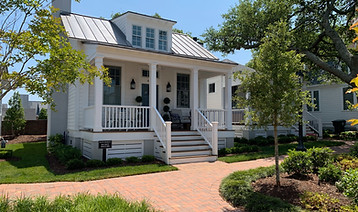
The smallest complete home — and one of the most useful types in the collection. A well-designed cottage gives a one- or two-person household a real house at a modest footprint: a front door, a porch, a sense of arrival, all at a scale that fits gently into an existing block or clusters into a cottage court. These are the plans that make attainable, human-scaled infill possible.
Village Houses
The everyday house of a traditional neighborhood — the type that does most of the work in giving a place its character. Generous enough for a family, disciplined enough to sit shoulder-to-shoulder with its neighbors, the village plan is the backbone of the walkable block.

Manors
The neighborhood's grandest single-family type — the house that terminates a vista, anchors a green, or crowns the best lot in the plan. Manors carry the fullest expression of traditional architecture in the collection, designed as the landmarks that give a place its sense of permanence and worth.

Multifamily
House-scaled buildings that hold several households behind a single dignified façade — the courtyard building, the small walk-up, the mansion apartment. This is the heart of the missing middle: real density that reads as a generous house rather than an apartment block, and the type most capable of adding homes without breaking the scale of a neighborhood.

Small Village Houses
Compact homes scaled for the densest, most walkable parts of a neighborhood — the cottages' slightly larger neighbors. Designed for narrow lots and close-set streets, small village plans hold the edge of the sidewalk, frame the public space, and deliver a comfortable home without demanding a large parcel.

Large Village Houses
The more substantial family home, designed to anchor a corner or hold a prominent lot without overpowering the street. Larger in program but still drawn to the proportions and detailing of the tradition, these plans show that size and good manners aren't mutually exclusive.

TownHomes/ Live-Work
Attached homes that bring real density to a street while keeping the dignity of an individual front door. The live-work variants put a shop, studio, or office at the ground floor with a residence above — the historic engine of the mixed-use main street, and one of the most flexible types for a developer building a walkable district.

Out Buildings
The supporting cast that completes a property — carriage houses, garages with quarters above, garden structures, and accessory dwellings. Small in footprint but large in usefulness, these plans add a rentable unit, a home office, or a guest house, and they're often the simplest first step toward gentle density on an existing lot.

Interested in the collection?
We work with developers, builders, and communities planning at every scale —
from a single building to an entire neighborhood. If any of these types fit what you're planning, get in touch and we'll walk you through the collection.
Looking to purchase an individual plan? Some of our plans are available for individual sale through